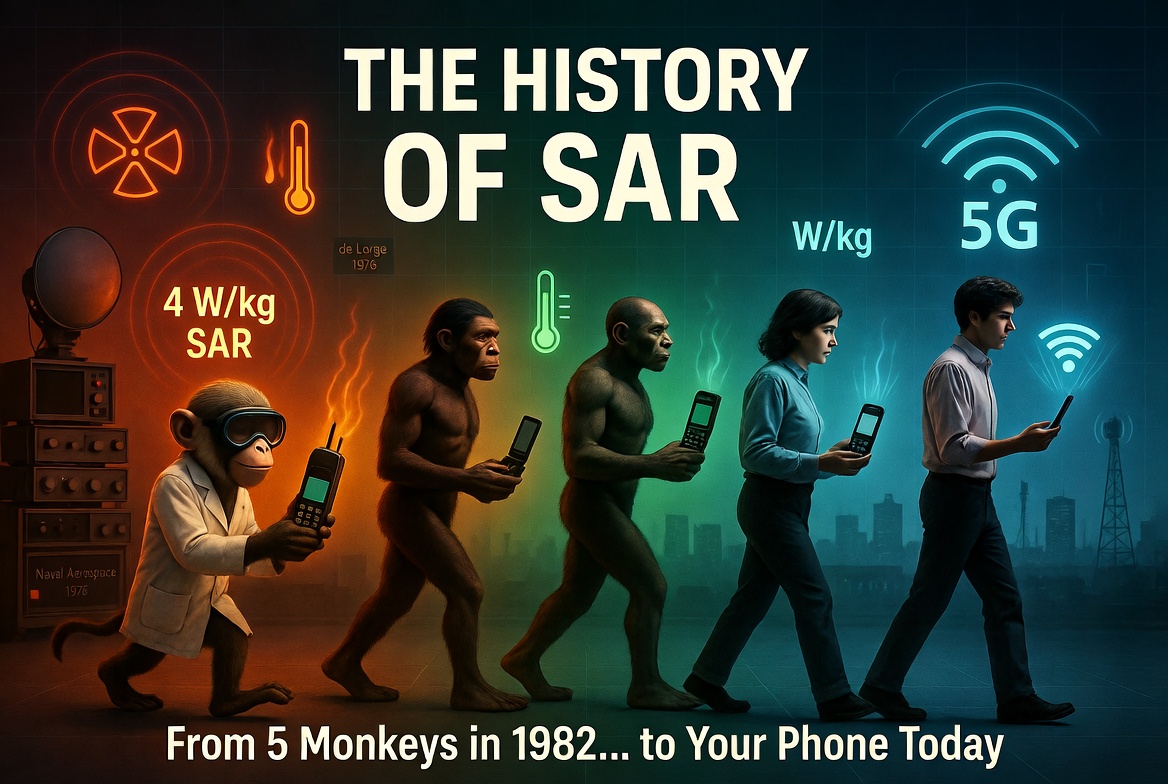
If you’ve ever wondered why your phone has to pass “SAR testing” before it hits the market — or why critics keep saying those limits are based on “just 5 monkeys and a 1-hour experiment” — this deep dive is for you.
SAR stands for Specific Absorption Rate: the rate at which radiofrequency (RF) energy is absorbed by your body, measured in watts per kilogram (W/kg). It replaced the old, crude “power-density” rules (measured in mW/cm²) because scientists realized the real danger isn’t how much energy hits the air around you — it’s how much actually gets absorbed and turns into heat inside your tissues.
Here’s the full timeline, with the exact studies that drove every major change.
1950s–1970s: Power-Density Only — The “Eye Hazard” Era
After World War II, radar technicians started reporting weird symptoms. The big worry? Cataracts in the lens of the eye (which has almost no blood flow for cooling).
- Rabbit and early primate studies (Kramar, Guy, and others) showed that focused microwaves could cook the lens proteins at power densities around 100 mW/cm².
- By 1958–1966, U.S. groups settled on a simple safety limit: 10 mW/cm² across 10 MHz–100 GHz. This was chosen because it was thought to limit core temperature rise to ~1°C — the same rule-of-thumb used in industrial heat stress standards.
- 1966: First national standard — ANSI C95.1-1966 (reaffirmed 1974). Flat 10 mW/cm² limit. No frequency dependence, no SAR calculations. Eye research and crude thermal models were the main drivers.
- 1971: The famous U.S. Navy bibliography by Zorach R. Glaser (AD0750271) compiled over 2,000 papers, including Soviet work on non-thermal effects, cataracts, and behavioral changes. It’s still cited by critics today as proof that “thermal-only” thinking ignored a lot of early warnings.
At this stage, there was no SAR at all. Limits were just “how strong is the field in the air?”
1982: The SAR Revolution — “Behavioral Disruption in 5 Monkeys”
This is the pivotal year everything changed.
ANSI C95.1-1982 threw out the old flat power-density rule and introduced whole-body average SAR as the basic restriction.
- The committee reviewed dozens of animal studies and declared the most sensitive, reproducible adverse effect was disruption of trained behavior (rats and monkeys pressing levers for food rewards while exposed).
- Key studies: J.O. de Lorge (Naval Aerospace Medical Research Lab, 1976–1984). Rhesus monkeys (often groups of just 5 animals) trained on operant tasks. At ~4–8 W/kg whole-body SAR (corresponding to ~1°C core temperature rise), the animals stopped working or showed clear performance drops after 30–60 minutes.
- Other supporting work: D’Andrea, Thomas, Lovely, Adair, etc. — all pointing to the same 4 W/kg threshold.
- The committee applied a 10× safety factor → 0.4 W/kg whole-body average SAR as the limit (averaged over 6 minutes, later 30 minutes in some versions).
- They also added frequency-dependent curves because of whole-body resonance (your body absorbs far more energy around 70–80 MHz).
Direct quote from the 1982 standard rationale (page 13): “The threshold for behavioral disruption is 4 W/kg… A safety factor of 10 is applied.”
This was the first time SAR became the official basis for U.S. (and later international) limits. Eye/cataract research was considered but rejected as the primary endpoint because it required much higher localized exposures.
You can read the full 1982 standard here: https://ehtrust.org/wp-content/uploads/2015/11/ANSI-National-standards-1982-safety-levels-for-human-exposure.pdf
1986–1992: The Two-Tier System Is Born
- NCRP Report No. 86 (1986) basically copied the 1982 ANSI approach.
- IEEE C95.1-1991/1992: Split the limits for the first time:
- Controlled/occupational: 0.4 W/kg whole-body
- Uncontrolled/general public: 0.08 W/kg (extra 5× safety factor)
- Localized “peak” SAR limits added: 8 W/kg (1 g tissue) occupational / 1.6 W/kg public (head/trunk).
- This is exactly what the FCC adopted in 1996 for cell phones, Wi-Fi, and towers — the rules still in force today (with minor updates).
1998–2020: ICNIRP and the Global Standard
ICNIRP (International Commission on Non-Ionizing Radiation Protection) adopted the same 4 W/kg behavioral threshold + safety factors in their 1998 guidelines (updated 2020). Most countries worldwide now follow either the IEEE/FCC or ICNIRP version — both rooted in the exact same 1970s de Lorge monkey data.
Why Critics Call This Foundation “Flimsy”
The 2026 Environmental Health paper by Melnick et al. (and earlier ICBE-EMF critiques) point out the same issues we’ve discussed:
- Sample sizes: often only 5 rhesus monkeys.
- Exposure duration: 30–60 minutes max — nothing like 24/7 phone use.
- Thermal-only focus: The studies deliberately stopped at the point where heating caused behavioral changes. Later research (NTP rat studies showing tumors at non-thermal levels, oxidative stress, fertility effects) was never incorporated into the basic restriction.
- Newer modeling (benchmark dose from larger datasets) suggests the 4 W/kg threshold itself may be too high for modern risk levels.
Bottom Line: SAR Was a Huge Scientific Advance… in 1982
Moving from crude power-density to actual absorbed-dose (SAR) was brilliant. It accounted for resonance, near-field phone use, and hotspots. But the underlying biological threshold — the 4 W/kg point where a few monkeys stopped pressing a lever — has never been updated for chronic, non-thermal, or low-level effects.
Every time you see a phone’s SAR rating (1.6 W/kg U.S. / 2.0 W/kg Europe over 1 g or 10 g tissue), you’re looking at a number that traces straight back to those Naval Aerospace Lab experiments from the Ford and Carter administrations.
Want to dig deeper yourself?
- Glaser 1971 Navy bibliography (the original 2,000+ paper collection): https://apps.dtic.mil/sti/tr/pdf/AD0750271.pdf
- de Lorge’s key 1976 monkey study: https://www.radhaz.com/docs/NAMRL%201222%20Behavior%20and%20Temperature%20in%20Rhesus%20Monkeys%20Exposed%20to%20Low%20Level%20Microwave%20Irradiation.pdf
- NTP rat cancer studies (the ones ICNIRP/FCC still say don’t change anything): https://ntp.niehs.nih.gov/sites/default/files/ntp/htdocs/lt_rpts/tr595_508.pdf
- 2026 Melnick critique (open access): https://link.springer.com/article/10.1186/s12940-026-01288-6
The science moved on. The exposure limits… not so much.