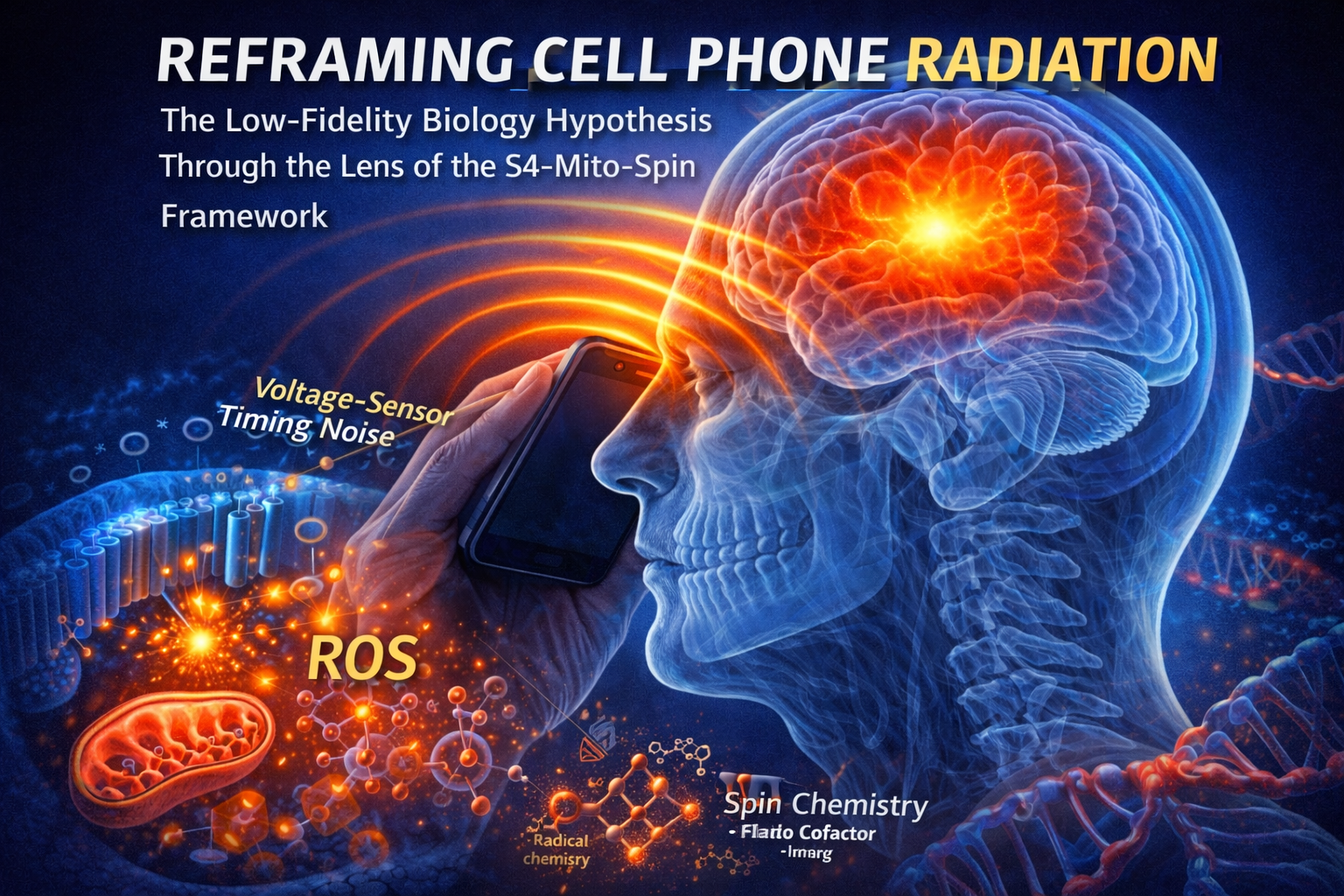
In the ongoing conversation about wireless radiation safety, it's time to move beyond simplistic narratives that paint RF exposure as a direct "carcinogen" or dismiss it entirely as harmless below thermal thresholds.
At RF Safe, we've long advocated for a more nuanced understanding—one that recognizes cell phone radiation as a subtle disruptor of biological fidelity. This isn't about RF causing cancer or other diseases outright. Instead, it's about how chronic, non-thermal exposures introduce upstream noise into the body's most precise signaling systems, creating a low-fidelity environment where the body becomes more susceptible to a cascade of downstream health challenges.
Drawing directly from our S4-Mito-Spin framework, this perspective unifies decades of research, explains the variability in study outcomes, and positions RF alongside other modern stressors like processed foods, air pollution, or chronic noise—contributors to entropic waste that erode optimal biological function over time.
Understanding Low-Fidelity Biology: The Upstream Disruption
At its core, low-fidelity biology refers to a state where the body's intricate signaling and metabolic processes lose their precision. Think of it like a high-performance orchestra where even slight timing errors in the rhythm section throw off the entire symphony. In biological terms, this starts far upstream—at the level of ion gating, redox reactions, and spin chemistry—long before manifesting as endpoint diseases.
The S4-Mito-Spin framework provides the mechanistic backbone for this hypothesis. It's not a speculative theory but a synthesis of established biophysical principles, peer-reviewed studies, and observed patterns in RF research.
Here's how it breaks down:
1. S4: Voltage-Sensor Timing Noise and Ion-Forced Oscillation
Voltage-gated ion channels (VGICs) are the gatekeepers of cellular communication, relying on positively charged S4 helices to detect millivolt changes and regulate flows of calcium (Ca²⁺), potassium (K⁺), and sodium (Na⁺). Pulsed, polarized RF fields from cell phones induce ion-forced oscillation (IFO), exerting Coulomb forces that jiggle these S4 segments. This injects erratic timing noise, disrupting the millisecond-precision needed for proper signaling.
The result? Mistimed ion bursts that overload downstream pathways. In tissues dense with VGICs—like the heart's conduction system, brain neurons, testicular cells, or endocrine glands—this noise propagates, creating a low-fidelity baseline where signals are less reliable. It's not an immediate threat but a gradual erosion, much like how inconsistent sleep patterns wear down cognitive performance over years.
2. Mito: Mitochondrial ROS Amplification and Redox Imbalance
Building on S4 disruptions, mistimed calcium influx stresses mitochondria—the cell's powerhouses. This triggers overproduction of reactive oxygen species (ROS) via the electron transport chain or NADPH oxidases, leading to oxidative stress, mtDNA damage, and chronic inflammation. In mito-rich tissues, this amplification turns subtle upstream noise into systemic signals of distress.
Here, RF acts as a co-contributor, biasing the body's redox environment toward imbalance. Studies like the National Toxicology Program (NTP) and Ramazzini Institute experiments show this in action: non-linear tumor responses at SAR levels as low as 0.001 W/kg in far-field exposures, with heart schwannomas and brain gliomas emerging not from direct DNA breaks but from accumulated oxidative and inflammatory burdens. Genetic profiling reveals mutations (e.g., in TP53) that mirror human cancers, underscoring how low-fidelity redox states foster vulnerability.
3. Spin: Radical-Pair Chemistry and Subtle Redox Tweaks
Even in tissues without dense ion channels or mitochondria, such as red blood cells, RF influences spin-dependent chemistry. Radical pairs in heme (e.g., hemoglobin) or flavin cofactors have electron spins that determine reaction outcomes. Weak RF fields bias these spins, altering recombination rates and enzymatic yields—shifting redox chemistry without needing thermal energy.
This pillar explains rapid, reversible effects like rouleaux formation (blood cell stacking) observed in human veins after smartphone exposure. It also ties into broader phenomena, such as enhanced efficacy of cancer-fighting drugs under magnetic fields, where spin manipulation modulates treatment responses. In essence, spin chemistry introduces a quantum-level fidelity loss, making biological processes more prone to errors in timing and efficiency.
How the Three Pillars Work Together
Together, these pillars create a chain: S4 noise feeds mito amplification, which interacts with spin-dependent redox, generating a low-fidelity milieu.
This isn't unique to RF—it's akin to how processed foods introduce metabolic noise through excess sugars and additives, or how polluted air burdens the lungs with oxidative particulates. All absorb "entropic waste," pushing the body toward disorder and increasing odds of downstream issues.
Downstream Effects: From Susceptibility to Manifestation
In a low-fidelity state, the body operates with reduced resilience. Immunology shifts due to signaling errors, making infections or autoimmune responses more likely. Metabolic processes falter, contributing to issues like insulin resistance or energy dysregulation. Neurological and developmental pathways, reliant on precise ion timing, become susceptible to disorders such as ADHD or cognitive decline. Fertility suffers in VGIC-dense testicular tissues, where ROS storms impair sperm quality. And yes, cancer risk rises—not because RF is a mutagen, but because chronic oxidative stress, inflammation, and epigenetic changes create fertile ground for cellular errors to accumulate.
Evidence Abounds
NTP/Ramazzini Convergence
Tumors in heart and brain tissues match human patterns, with non-monotonic doses explained by resonance in S4-sensitive systems.
Tissue Selectivity
Effects concentrate in S4/mito hotspots, unifying findings on infertility, immune drift, and blood rheology.
Low-Dose Realities
Benchmarks at 0.2–0.4 W/kg overlap everyday exposures, showing how subtle fidelity losses compound over time.
Spin-Supported Interventions
Magnetic fields boosting drug efficacy highlight how modulating spin chemistry can counter low-fidelity states, reinforcing RF's role as a disruptor.
This framework resolves "sporadic" results by factoring in exposure variables (frequency, modulation, geometry) and biological states (circadian phase, antioxidant levels). Null studies? Often due to mismatched parameters that miss the resonant windows where low-fidelity emerges.
Why This Reframing Matters: From Alarm to Action
Framing RF as a low-fidelity enabler shifts the dialogue from fear-mongering to empowerment. It's not the sole villain—it's one of many opportunistic factors in our modern environment that exploit biological vulnerabilities. Like avoiding processed foods or filtering air, mitigating RF involves smarter habits: use speakerphone, maintain distance, opt for wired connections, and choose low-SAR devices.
At RF Safe, this drives our advocacy for the Clean Ether Act—policy reforms for safer waveforms, reduced exposures, and reinstated research. It also informs products like our TruthCase™, designed to directionally shield without amplifying signals, preserving fidelity where it counts.
The S4-Mito-Spin framework isn't just theory; it's a roadmap to understanding how non-thermal RF contributes to the entropy of modern life. By addressing upstream fidelity, we can reduce downstream risks across cancer, neurological, developmental, fertility, and metabolic fronts. Let's build a world where technology enhances life without eroding its precision—join us in pushing for evidence-based change.